
The Exit Strategy for Educators: When a Mental Health Sabbatical Becomes a New Life

Youth creatives and impact-choreographers collaborate on Ms. Marisha’s visual story project
There is a particular kind of heartbreak that comes with outgrowing the very identity that once gave your life meaning.
For many educators, that heartbreak does not arrive in one dramatic moment. It comes in layers. In fatigue that no weekend can fix. In the quiet resentment of being asked to hold entire systems together with spirit, sacrifice, and shrinking support. In the slow realization that what once felt like purpose now feels like depletion.
And still, leaving can feel almost unspeakable.
Not only because teaching is a profession, but because for many of us it is also a moral identity. To be an educator is to be someone who cares, someone who stays, someone who stretches. An educator is someone who makes a way out of almost no way at all. So when educators begin imagining life beyond the classroom, the question is rarely just, “What else could I do?” It is often, “Who am I if I am no longer this?”
I know that question intimately.
I did not leave education because I stopped caring. I left because I cared enough to tell the truth about what my life and body could no longer sustain. What began as a mental health sabbatical became something much bigger: a confrontation with the parts of my life that had been built on endurance rather than alignment. And once I could see that clearly, returning to the old structure no longer felt like going home. It felt like abandoning myself all over again.
That is a difficult truth to admit when the world rewards self-erasure dressed up as dedication.
AZ-based women creatives + impact professionals collaborate on visual monologue performance
But I am increasingly convinced that one of the most important conversations happening right now is not just about burnout. It is about permission. Permission for educators to imagine that their gifts do not disappear when they leave the classroom. Permission to believe that what made them excellent in one setting may make them extraordinary in another.
Because educators are not “just” teachers.
We are facilitators of growth. Translators of complexity. Designers of human experience. Storytellers. Pattern-recognizers. Community-builders. Cultural workers.
We know how to read a room, hold a thread, distill meaning, and make people feel seen. In another era, those gifts may have kept us in one institution for thirty years. In this era, they may be preparing us for entirely new terrains: media, partnership development, community strategy, wellness facilitation, creative production, brand storytelling, workforce development, social impact design.
The pivot is not random. It is often deeply coherent.
What looks from the outside like a career break may actually be the beginning of vocational accuracy.
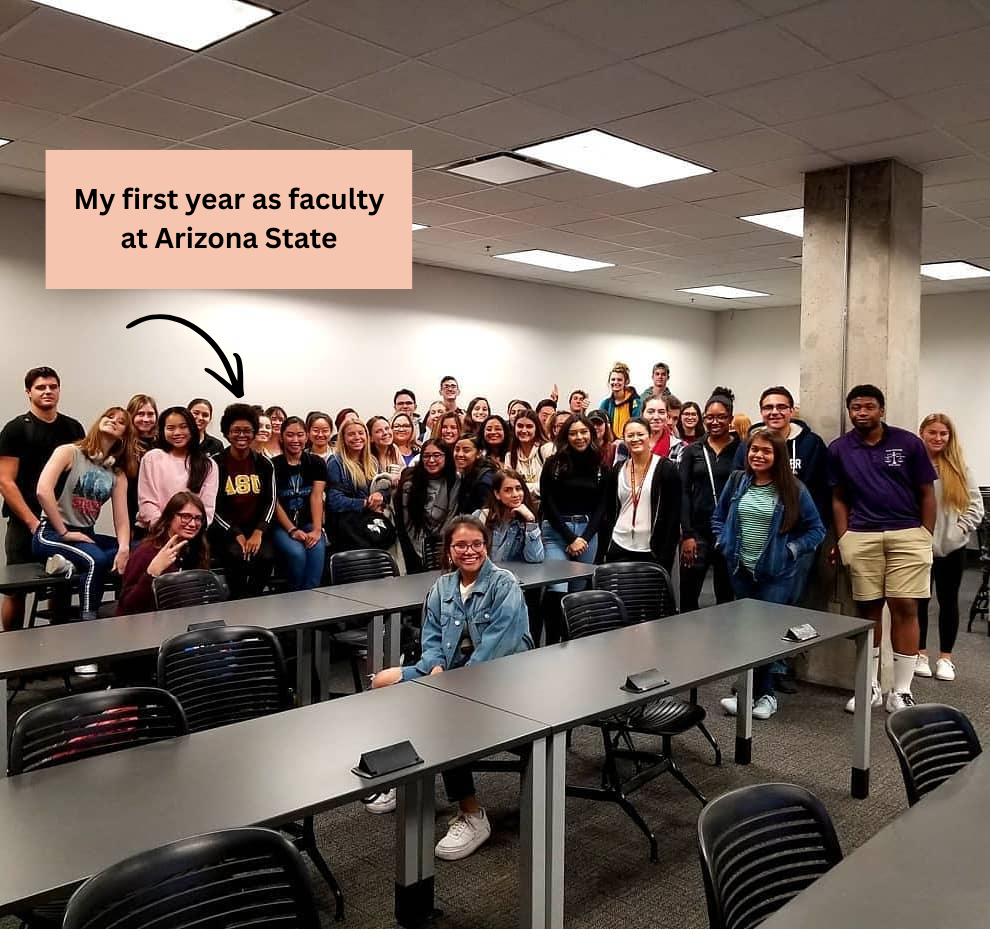
Ms. Marisha and her students on the last day of her first semester at Arizona State University
That is part of what gave birth to Please, BARE With Me. I wanted language for what happens after the identity collapse. After the sabbatical. After the polished explanation that makes other people comfortable. I wanted to build something for people who are no longer willing to perform wellness, success, or happiness while quietly falling apart. I wanted to create meaningful media for the in-between space, the space between no longer and not yet, the space where a person is not lost, but becoming.
For educators in particular, that becoming can be disorienting. We are trained to be useful in visible ways. We are often praised for how much we can carry. We can mistake over-functioning for character. And because education is so relational, leaving can feel like betrayal, even when staying has become a betrayal of self.
But there is another way to understand the transition.
Maybe the exit is not evidence that you failed your purpose. Maybe it is evidence that your purpose can no longer fit inside the container you once gave it.
Maybe what is ending is not your usefulness, but your over-identification with one socially approved version of it.
Maybe the classroom was never the final expression of your gifts. Maybe it was one chapter.

Ms. Marisha filming promo trailer for Please, BARE With Me at Desert Rose in Sedona, AZ
This is why I resist the flat, transactional language that often surrounds career pivots. Not every transition is about “transferable skills,” though those matter. Some transitions are about recovering a life. Some are about grief. Some are about finally listening to the signal beneath the survival pattern. Some are about building a future that has room for your health, your truth, your creativity, your relationships, your rest, and your imagination.
That is a different kind of wealth.
Not just financial wealth, though that matters. But for me, ‘Whole Life Wealth’ is what I now call it. The kind that asks whether your life actually fits you. Whether your work reflects your values. Whether your success requires self-betrayal. Whether the person the world depends on has a life that can hold her, too.
For the educators standing at the edge of a transition, this is what I want to say:
Leaving is not always quitting.
Sometimes it is remembering.
Sometimes it is repair.
Sometimes it is the first honest thing you have done in a long time.
And when that honesty opens, new paths become visible.
Not easy paths. Not linear paths. But real ones.
The future belongs to people who can teach, connect, translate, convene, feel, and imagine new ways forward. Educators have been doing that all along. The only difference now is that more of us are beginning to ask whether those gifts might belong in rooms we were never told to consider.
I think they do.
And I think the next generation of meaningful work will be built, in part, by people who had the courage to leave roles and environments that no longer honored the fullness of who they were becoming.
That is not failure.
That is an exit strategy.
