
Union Station LA: Katie E. Johnson, The Legacy + Future of Black Farmers
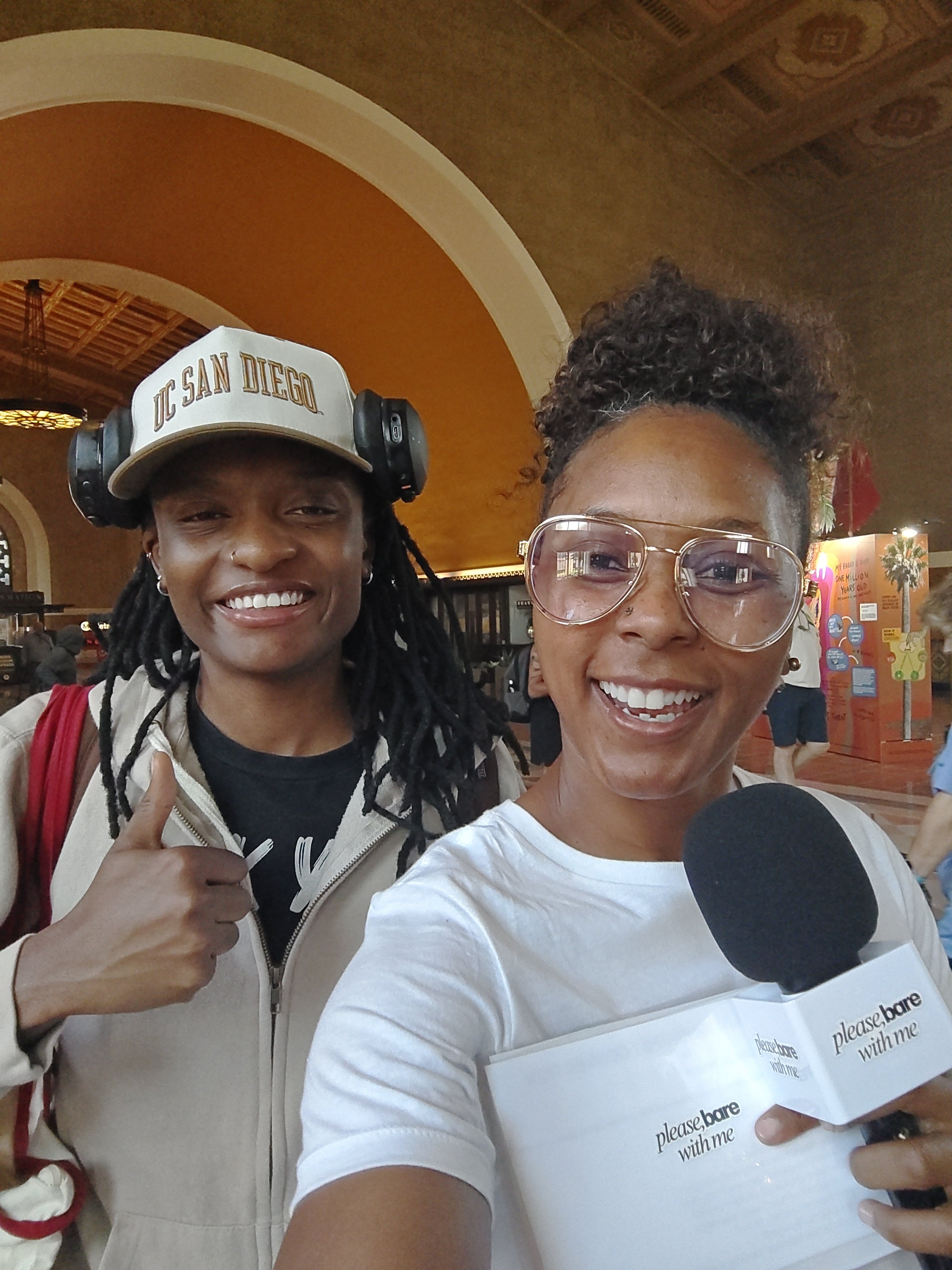
Katie E. Johnson + Ms. Marisha at Union Station LA
Sometimes Re-Writing the Story Means Remembering What Was Already There
What one Union Station Conversation Taught Me About Land, Media, Pace, and the Stories We Inherit
When I started approaching strangers for Please, BARE With Me, I didn't always know what the conversations would eventually become.
I knew I was interested in the stories beneath the roles we perform. I knew I wanted people to have different doorways into vulnerability including conversation, creativity, nature, movement, sound, and expression. And I knew I was curious about what happens when an ordinary public encounter creates enough permission for someone to say something real.
At Union Station in Los Angeles, I asked Katie Johnson:
What is a story you are currently rewriting about your life right now?
Her answer brought us to agriculture.
Katie spoke about her relationship to farming, Black farmers, and a history she believes more Americans need to understand, particularly the role Black families have played in agriculture and in the economic life of this country, and what has been lost as fewer Black families have remained connected to farming.
Her response carries historical weight beyond our brief conversation.
USDA data show that Black farmers operated approximately 41.4 million acres in 1920. By 2022, Black-operated farms and ranches covered about 5.3 million acres, and the Census of Agriculture counted 46,738 Black producers which is only 1.4% of all U.S. producers. USDA's own historical research documents decades of racial discrimination that restricted Black farmers' ability to acquire and retain land.
But what has stayed with me is not only the history Katie named, it’s what happened when I returned to the conversation for editing and posting.
I Hear Her Differently Now
When I recorded this interview, I had not yet developed the language I use today for my interdisciplinary artistic practice.
I was asking questions, listening, recording, and mostly following curiosity.
Some of the work felt like media, and because of my background, these conversations also felt educational. Some encounters got personal, while others felt like a wellness and active listening practice. I did not yet fully recognize that these were different expressions of a recurring way I move through the world.
Today I would describe that process as:
notice → pause → interpret → express → encounter another perspective → reconsider what is possible.
Katie's answer occupies that fifth movement for me.
Encounter another perspective.
She unknowingly introduced something that I could not have produced by sitting alone and thinking harder, and returning to the footage now while I am examining land, regeneration, pace, transition, and my own changing relationship to professional and creative identity allows me to encounter her answer again from a different place.
That matters because interpretation is not fixed and neither are we.
Sometimes Rewriting Isn't About Inventing a New Story
I initially asked Katie what story she’s rewriting about her life, but what I now understand is that sometimes, rewriting isn’t just about inventing a new story, once we have enough time to sit and think about it, we might actually find that it means recovering a story we were not taught to value.
Sometimes it means understanding an old experience differently or recognizing that what we considered ordinary, outdated, unsuccessful, uncomfortable, or irrelevant holds information we were not prepared to perceive the first time.
That’s part of what nature has been teaching me too. During my own personal and professional life transition, walking became a practice that helped me think without demanding an immediate answer or next step to what I was living through.
Later, I started gardening partly because I needed to practice a relationship with progress that I could not control completely. Yes, I could prepare conditions for the seeds to grow, pay attention to how much sun and water I was giving them, and I could respond to what I was changing.
But what I couldn’t do was bully a seed into respecting my preferred timeline, and that relationship with pace has increasingly entered my creative practice.
Slowing down is not incidental to how I work, it’s part of the method.
Enough time allows another interpretation to surface, enough distance allows an inherited role to become visible, enough listening allows another person's experience to complicate our own, and in the case of this interview with Katie, enough replaying of footage from months prior can suddenly teach us something new.
Media Has A Role
Transitioning from education in its traditional sense has left me thinking a lot about media as cultural transmission.
Television, music, film, social media, advertising…all of these mediums help teach us what success looks like, whose histories matter, what adulthood should resemble, what bodies are desirable, which kinds of labor deserve prestige, and what progress is supposed to feel like.
But the same mediums can be reclaimed.
They can preserve stories that might otherwise disappear, allow someone to tell history from where they stand, complicate narratives we inherited, help us encounter people outside our immediate experience, and they can give us enough material to reconsider what we thought we knew.
That is one of the things I now understand Please, BARE With Me to be doing.
It isn't simply collecting people's answers. The conversations change the viewers and the person asking the questions too. Increasingly, I’m interested in what happens when those conversations move between media, art, place, technology, and real human relationship…when an prompt becomes an interview, an interview becomes an experience, an experience introduces another person, and that person’s perspective changes what becomes possible to imagine.
Katie gave me one of those moments at Union Station. Her story asked me to look toward the land, and now I am listening and reminded to respond to my life’s unfolding differently. Being at peace with my pace, process and progress has allowed me to make more sense of the power held within these brief encounters.
What person, place, practice, or medium has helped you rewrite a story by seeing it differently rather than simply replacing it?
Interview coming soon…subscribe here + be the first to know when new episodes drop!
